HELEN KELLER
A WOMEN WHO NEVER STOP HARD WORKING

Introduction
Helen Adams Keller (June 27, 1880 – June 1, 1968) was an American author, disability rights advocate, political activist and lecturer. Born in West Tuscumbia, Alabama, she lost her sight and her hearing after a bout of illness when she was 19 months old. She then communicated primarily using home signs until the age of seven, when she met her first teacher and life-long companion Anne Sullivan. Sullivan taught Keller language, including reading and writing. After an education at both specialist and mainstream schools, Keller attended Radcliffe College of Harvard University and became the first deafblind person in the United States to earn a Bachelor of Arts degree.[1]
Keller was also a prolific author, writing 14 books and hundreds of speeches and essays on topics ranging from animals to Mahatma Gandhi.[2] Keller campaigned for those with disabilities and for women's suffrage, labor rights, and world peace. In 1909, she joined the Socialist Party of America (SPA). She was a founding member of the American Civil Liberties Union (ACLU).[3]
Keller's autobiography, The Story of My Life (1903), publicized her education and life with Sullivan. The playwright William Gibson wrote a theatrical adaptation, The Miracle Worker, in 1959, which he adapted as a film under the same title in 1962. Her birthplace has been designated and preserved as a National Historic Landmark. Since 1954, it has been operated as a house museum[4] and sponsors an annual "Helen Keller Day".
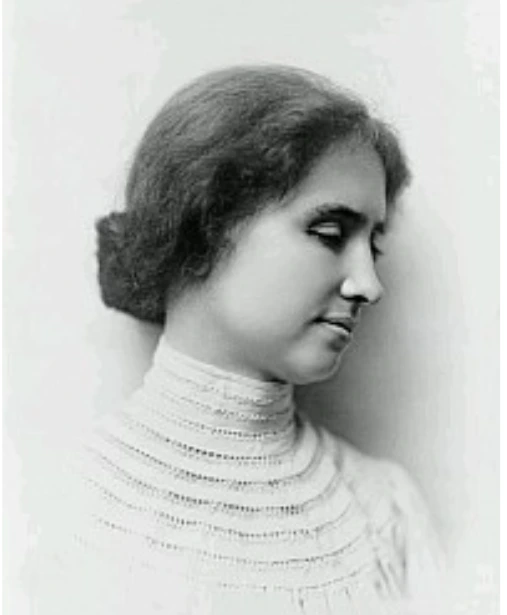
HELEN KELLER RELATION WITH TEACHER
A remarkable student is often inspired by a remarkable teacher. While Helen Keller was the first deaf-blind person to receive a Bachelor of Arts degree (and one from Radcliffe College in 1904), she maintained a life-long friendship with her first teacher, Anne Sullivan -- a relationship which is described in Keller's autobiography, The Story of My Life.
Anne became Helen's teacher at the Kellers' home in Tuscumbia, Alabama. She began teaching seven-year-old Helen by spelling out favorite words in Helen's palm, then went on to numbers, and the Braille system.
Sullivan encouraged Helen to attend the Perkins' School and moved with her to Boston in 1888. Anne's protégée quickly became a model for extraordinary accomplishment in the education of persons with disabilities, as both Helen and Anne went on to receive national and international recognition from leading institutions and professional organizations.
HELEN RELATION WITH PARENTS
Helen Keller was born in Tuscumbia, Alabama, in 1880. She developed a brain fever at just 19 months old — later speculated to be either meningitis or scarlet fever — which left her deaf and blind.
Losing both her sight and hearing at such a young age proved challenging, as you'd expect. Without easy access to occupational therapy or specialized schools, as many disabled children have today, Helen had to adapt to her environment on her own. She worked to feel and smell her world through her remaining senses.
Many families with nonverbal or disabled children know how that lack of communication can be extremely frustrating for them and often lead to tantrums. Helen Keller was no different, throwing things and eating from others' plates to get her way.
In 1886, Helen's mother contacted Alexander Graham Bell, who was working on a hearing device for the deaf. He led them to the Perkins Institute for the Blind in Boston, where Anne Sullivan was studying. With a visual impairment herself, Anne was a star student at Perkins Institute and traveled to Alabama to work with Helen. Through their hard work, Helen learned to use sign language and read braille by the time she was 10 years old!
HELEN’S CHILDHOOD ACHIEVEMENT
Throughout her lifetime, Helen worked hard to improve herself and the lives of others. She was the first person who was DeafBlind to earn a college degree in the United States from Radcliffe College, at a time when many people didn’t think women should even go to college. Although she did learn braille, Helen still often communicated with the help of Annie spelling into her hand. However, Annie was not allowed to be with Helen during any of her exams because there was an incorrect assumption that it was Annie who was actually doing all the work.
Radcliffe did not provide any accommodations. Accommodations were made possible through the help of Annie and Helen’s many friends, who paid to have her textbooks transcribed into braille. She took notes in class using a slate and stylus, a handwriting tool for taking braille notes.
In other words, Helen earned the degree all on her own, with accommodations of the time – just as a student would today. This was even more challenging because, at the time, there was no universally accepted form of braille. One test Helen took was in the form of braille she’d only been acquainted with a few days before, yet she persevered. She went on to learn braille in German and French – proving she had an incredible gift for language and communication. Ultimately, Helen preferred the braille that’s the standard today and used a braille writer. She was also an excellent typist who typed up the manuscripts and speeches she wrote in braille. As she became increasingly famous, she had a team to assist her, including Annie and, later, Polly Thomson, who would review her typewritten work.
Helen went on to be an outspoken advocate for many issues. She didn’t simply stand up for people who are DeafBlind, blind, or have other disabilities. She was an advocate for all people. Many people know Helen for her childhood story, but we do her a disservice if we don’t learn more about her adult life and the causes she championed. During a period of widespread book burning in Germany before World War II, Helen Keller’s work was targeted. She penned a letter to the student body, directly addressing their actions. The letter began with the impactful line: “History has taught you nothing if you think you can kill ideas.”
HELEN STRUGGLE’S IN STUDIES
Keller was born a healthy baby. She began walking and talking around her first birthday. However, her development was cut short just six months later when she became ill with what may have been scarlet fever.
After spending several days with a very high temperature, Keller was left permanently blind and deaf.
The next few years of Keller’s life were a struggle for her and her parents. Keller needed help connecting and communicating with the outside world, and her mother and father were not equipped with the necessary skills.
Thankfully, Sullivan’s arrival when Keller was six years old would change things for the better in the Keller household.
During the first few weeks with Sullivan, Keller threw many tantrums and hit, kicked and pinched her teacher. She even knocked out one of Sullivan’s teeth during an outburst.
Sullivan remained patient and consistent with Keller. She used a technique called “fingerspelling” to describe the names of everyday objects into Keller’s hand.
At first, Keller didn’t understand the meaning behind the fingerspelling. Then one day, everything clicked. Sullivan pumped water over Keller’s hand while spelling the word “water.”
Keller suddenly made the connection. Years later she wrote about her experience, “That living word awakened my soul, gave it light, hope, joy, set it free! …Everything had a name, and each name gave birth to a new thought.”
From that point on, Keller and Sullivan were inseparable as student and teacher. Keller enthusiastically learned everything she could about the world around her.